
Planting with Purpose: Leveraging Pittsburgh’s Urban Forest for Climate Resilience
The Problem
Pittsburgh has long identified trees as a priority. Back in 2021, the City publicly stated a goal to plant 100,000 trees by 2030. Likewise, the City’s Climate Action Plan calls for increasing the overall City canopy cover from 42% to 60% by 2030, halting “tree canopy loss due to development,” and using green infrastructure (including trees) to manage stormwater. However, despite these ambitious goals, Allegheny County (where Pittsburgh is located) has been losing close to 2% of its tree canopy every five years since 2010. More than 4,100 acres (~3000 football fields of tree canopy) were lost between 2015-2020.
At the same time, Pittsburgh is facing increasing risks from impacts of climate change. Projections show more than 37 days over 90°F annually by midcentury (a 640% increase from the 1990s) and more than 27,000 properties in the city are at risk of flooding over the next 30 years. Given this reality, the city saw an opportunity to more strategically leverage its urban forest as climate infrastructure. Moreover, the city recognized that its traditional by-request approach to tree planting needed to evolve, as trees were being planted where residents had the time and energy to request them, not necessarily where they were needed most.
Outcomes
This project outlined a path forward for a more robust urban forestry program for Pittsburgh, treating trees like the critical infrastructure they are and prioritizing planting in the areas of the City that face the greatest impacts from climate change.
RCC supported the City in exploring avenues for funding and formalizing an expanded tree planting program. At the same time, the updated standard operating procedures developed through this project and a newly launched Interdepartmental Urban Forestry Working Group are already making a difference in the City’s approach to growing the tree canopy while a Municipal Canopy Cohort funded through RCC’s grant and led by The Congress of Neighboring Communities (CONNECT) and Tree Pittsburgh is scaling learnings throughout Allegheny County. By creating clear protocols for using data to guide decisions and modeling how coordination and partnerships can work in practice, this project helped ensure that Pittsburgh is equipped to pursue equitable urban forestry investments that address climate vulnerability across the city’s neighborhoods.
Our Work Streams
- Developing the “Tree Impact Zones” methodology for prioritizing tree planting locations based on where they could deliver the greatest climate resilience benefits to vulnerable populations.
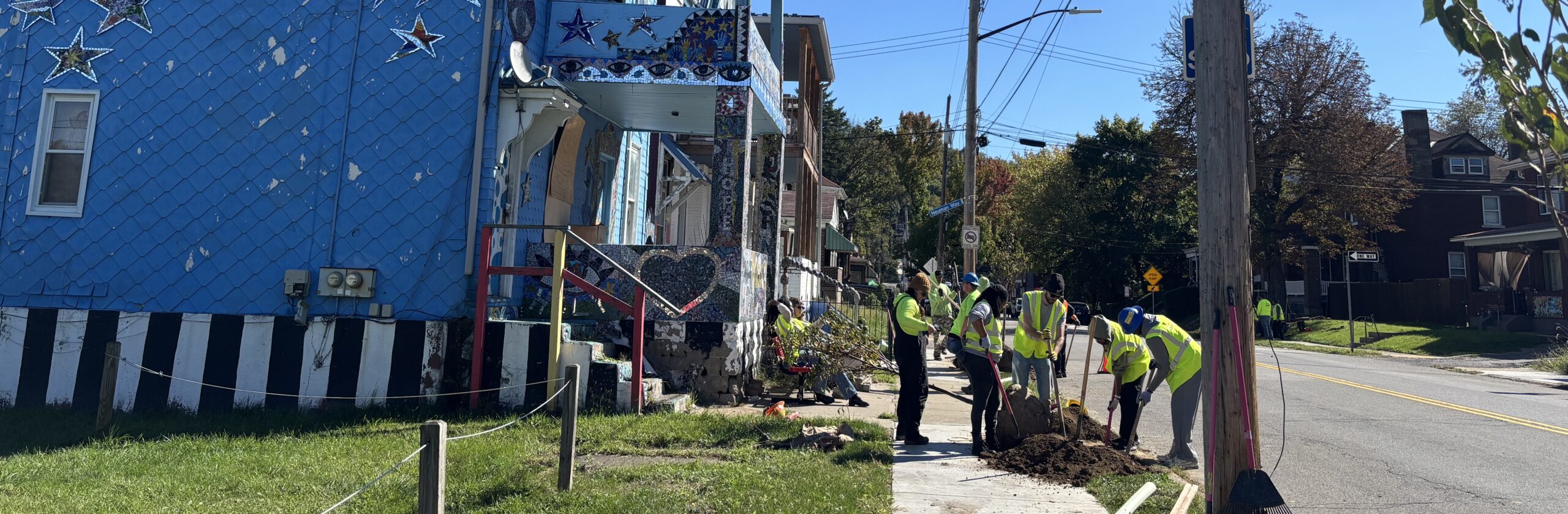
- Partnering with a community-based-organization, Tree Pittsburgh, to carry out pilot tree planting events in Hazelwood, Beltzhoover, and Homewood—neighborhoods with low to medium canopy, high tree opportunity (room for trees in the right of way and on private property), and high heat and flood risk.
- Updating the Standing Operating Procedure for tree planting to incorporate data into decision making.
- Exploring avenues for funding and formalizing an expanded tree planting program.
- Scaling learnings throughout the region through the launch of a Municipal Tree Canopy Cohort, led by CONNECT and Tree Pittsburgh, that brought together 29 Allegheny County municipalities to share findings and address urban forestry challenges.
Impact Numbers
Nearly 300
trees planted or distributed across three neighborhoods
8,000
residents benefiting
$276,400
directed to implementation
5
pilot tree planting events
Key Findings
Nearly 300 trees were planted or distributed across Hazelwood, Beltzhoover, and Homewood, and the City has updated its standard operating procedure to prioritize neighborhoods facing the greatest climate vulnerability. That procedural shift shapes every future planting cycle; maintenance cost, rather than planting cost, remains the constraint the financing work addresses.